Call of Duty
World at War (2008)
Analysis of Form and Content
A) Purpose: This game has been created primarily for entertainment purposes and develops from the previous title Call of Duty: Modern Warfare (2007) continuing Activisions greatly successful Call of Duty franchise, which continues to this day. This title was created for PS3, Xbox 360 and PC As of November 2013, the game has sold 15.7 million copies on these platforms. Other adaptations with the same titles have been created for the iPhone, PS2, Wii and other handheld consoles.
B) Form: World at War (WAW) is a unique game in contrast to other titles in the COD franchise, its feel and look have been purposefully created for the games environment and relate to its WW2 setting and genre, while also playing into its themes.
Mis-en-Scene:
The atmosphere that has been created in WAW is a dark and gritty one that has been created by the developers use of lighting, texturing and also sound design. This was clearly an intentional decision, as early concept art (shown below) shares similar looks to the final game.
Mis-en-Scene:
The atmosphere that has been created in WAW is a dark and gritty one that has been created by the developers use of lighting, texturing and also sound design. This was clearly an intentional decision, as early concept art (shown below) shares similar looks to the final game.
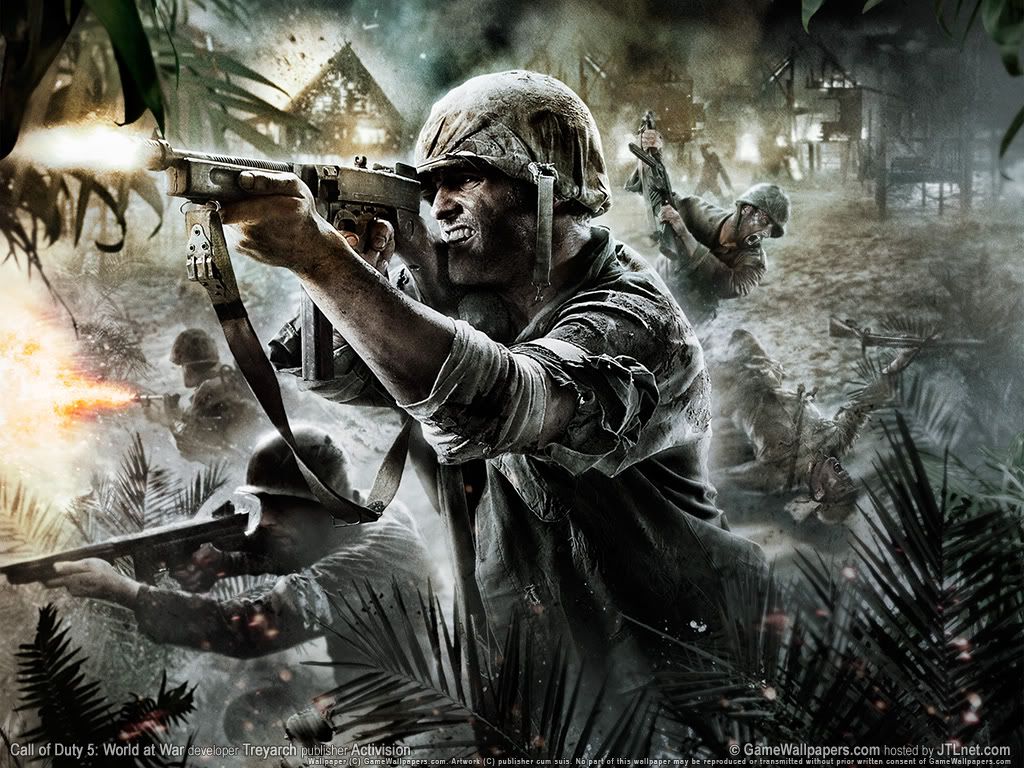
I think the reason for the use of this feel and look is to express the brutality of the conflict and relate to the dark, violent and bloody gameplay, this is mostly demonstrated by the low key lighting that creates a stark contrast between light and dark as the are hard divisions between the two suggesting a more painterly style of lighting with a harder qualities that match the style of the game.

Another important aspect of creating the games atmosphere was creating realistic models with accurate uniforms and weapons the game has achieved this, and a lot of research into the era was done:
Below are character models created for the game wearing the correct uniforms and even hairstyles for the time period.


Camera Angles:
In terms of camera angles the entire game is set in a first person perspective which applies to all call of duty games, the advantage of this is that it adds to the immersion of the story and grabs the players attention. Another advantage of the first person perspective is its huge popularity in the gaming industry something which automatically gives the game a lot of attention.
Sound:
Audio design in game development is extremely important, audio helps to immerse the player in the scenario and brings the virtual world to life. This means that capturing the correct sounds for the game is vital. However one main difference between audio in games and in film is that in games audio sources must be simulated in a 3D environment, this is called occlusion. The new technology of occlusion, changes the sound made by nearby object depending on objects blocking its path e.g. walls, has been added to World at War.
The game has various levels of "muffled" sound depending on the objects it travels though e.g. a more muffled sound through a thick wall compared to a slightly muffled sound through a thin short wall. For the first time in a Call of Duty game, the player is able to tell the difference between someone walking next to the player and someone walking above or below the player, as well as telling the difference between a shot fired in the distance and a shot fired close by, but behind a solid object.
The other technology of Flux was also developed using field recording systems. The World at War crew traveled to a desert with mountains on both side of the range to test the frequencies of sounds made by World War II weapons. Microphones were placed 60 yards (55 m) behind and 60 yards in front of the gun to test the echoes. This was later replicated and developed in the studio for the game software. It means that players will be able to pinpoint a sniper rifle shot, as it reflects off them, as well as hearing the initial 'pop' of a hand grenade blowing up and then the grenade's loud "whoosh" sound that begins where the grenade blew up, and ends behind the player. The flux system also combines with the occlusion system to make a fully immersive audio environment.
To record the voices for games characters the studio hired voice actors for all characters and go through a process similar to that in creating 3D animations, voice actors such as Gary Oldman starred as main characters in WAW and will have in depth understanding of the story and their character.
Music is another vital component in the development of video games as it can be used in ways that can follow the psyche of the gameplay, helping to emphasise emotion, drama and also the intensity of the game. This has been done remarkably well in World at War as the soundtrack has a range of tracks that are all unique to the levels and content that they accompany e.g in the pacific themed missions the sound motif is used to signify the jungle and also enemy, shown below is a music track designed for one of the levels in the Pacific;
Likewise the music from the eastern front campaign is very comparable to soviet military march music from the era. In most instances this music will begin usually when a significant event is happening in the game, such as the beginning of a mission or a specific moment in the story that the developers want to highlight. Below is an example of the what I'm demonstrating;
C) Content:
Call of Duty World at War is set on the Eastern and Pacific fronts of World War 2, where the player plays as a Russian conscript and an American Marine. The story is based at historical battles throughout the war, with a twist of fiction.
Like most games WaW consists largely of two main features Campaign mode (story mode) and multiplayer mode. Campaign mode is comparable to a film, there is a set story that is completed by the player successfully achieving the objectives of the level allowing them to progress to the next stage. As the player in WaW has complete freedom over the movement of their character they can chose how they do this, but ultimately gameplay is usually similar as the mission will take place in the same 'map' and they will have to follow the set path resulting in linear gameplay that contains set game events e.g cut scenes or explosions.

The advantage of this is it gives the developers more control and can create cinematic scenes like you might find in films and can help to add more drama to the game and also immersion, however a disadvantage of this is it reduces the actual playing time which is usually the main reason consumers of these products purchase the game, this means that developers must create a good balance of the two.
Multiplayer mode however is almost an entirely different style of game the player can choose a range of 'game modes' which provide generic objectives for 2 opposing teams to complete, although multiplayer mode uses elements relating to the campaign mode the gameplay allows for more freedom and no forced actions, this means that the content is highly replay-able as each match can vary in time, pace and situation.

D) Meaning:
If any Call of Duty game has the most meaningful message to it, it would be World at War. From the colour schemes, sound design, gameplay mechanics and other visual elements each aspect of the game was created the way it was for a reason. The reason for this was to create the most harsh, gritty, brutal and immersive environment ever created in a WW2 FPS shooter, in order to evoke emotion from the player and give them a deeper understanding of the story. To do this the developers understood that the best way to emphasise this would be to use dark tones in all visual elements of the game, an example of this would be the feature of gibbing.
Gibbing is commonly found in more mature video games and is the feature that allows enemies to be broken up into 'Gibs' adding excessive amounts of gore and brutality to the combat, this was the first time this was done in a Call of Duty game and only appears in titles by Treyarch. Although described as disturbing by some critics the addition of this feature heightens the intensity of the game and helps to accurately represent the horrors experienced during combat, this could be seen as an attempt to show respect towards veterans by not censoring the horrors of war.
E) Genre:
In terms of Game genre WAW at war is a First person shooter. A First-person shooter (FPS) is a video game genre centered on gun and projectile weapon-based combat through a first-person perspective; that is, the player experiences the action through the eyes of the protagonist, and in some cases, the antagonist. The first-person shooter shares common traits with other shooter games, which in turn fall under the heading action game. From the genre's inception, advanced 3D or pseudo-3D graphics have challenged hardware development, and multiplayer gaming has been integral. In terms of the story within the game the missions and characters are fictional, however are also based on real events.
F) Intended Audience:
Call of Duty WAW has been intended for a male audience of teens and young adults, especially those with interests in WW2. The game has a mature age rating for Violence and Gore so is suggested for those of the ages 16 and upwards. Due to its use of gore the game has a feature that allows for the disabling of such features in order to appeal to a wider audience.

G) Production Process:

Games production is divided into three main stages, all of which contain multiple processes that are key to developing a good game.
Pre-Production:
Pre-production or design phase is a planning phase of the project focused on idea and concept development and production of initial design documents. The goal of concept development is to produce clear and easy to understand documentation, which describes all the tasks, schedules and estimates for the development team. The suite of documents produced in this phase is called production plan. This phase is usually not funded by a publisher, however good publishers may require developers to produce plans during pre-production.
A pitch is the initial game proposal to management within the development company and then the publishers e.g Activision, publishers are the companies that commission the title, this means they have a lot of control over the developer as they're funding them so can cancel or delay a project at any moment. This will summarise the games main selling points and why it would be profitable, which is the main objective for publishers. If this pitch is given the green light then development into the next phase will go ahead.
This next stage is known as the concept, a concept further develops from the pitch by detailing gameplay elements and concept art. For Call of Duty concept is one of the core stages, as decisions to what time period the game will be set in have huge impacts on gameplay, story and characters. Research would involve communication with fans about what they want in Call of Duty, this would involved contact through social media in order to discover what new features fans would like, this data could be collected from older titles. It is also at this point that a small crew of developers will be assembled to create quick prototypes to get a feel for the game they're creating.

Production:
Once the concept process is complete the main stages of production begin, the rest of the dev team is hired and productivity is maximised with teams specialising on smaller projects that will be combined for the final game. Ensuring that the game keeps to the correct style is vital, to ensure that this is the case their are strong communication links between teams, previous concept art is also used to guide devs.
Now full responsibility for the games sales and gameplay is placed on the developers, designers, programmers, artists and sound designers will band together in an effort to produce the highest quality game possible.
For programmers and designers this involves developing the game engine that effects the games physics and gameplay that will usually define the player base the game will attract. During this time artists will develop game characters, objects, models, textures and maps. Artists also design Heads up display e.g Crosshairs, ammo count and team details, it is important that all of these art assets relate to the theme and context of the game e.g If this game is set in the future then artwork takes on a more futuristic style.

With each year fans expect innovation and higher fidelity graphics while having the game keep its core gameplay mechanics, this means with every year the development studio has to remodel, retextured, recode and improve its core game this also means developing new lighting systems and AI. Sound design is also another vital element of the games production and has to suit the theme, genre and also individual mission/map.

One of CoDs main features is its multiplayer this is why there are usually two teams within the production team, one dedicated towards the multiplayer aspect of the game and the other dedicated towards the single player experience.
For both teams game mechanics and map design is essential to making a great game that players enjoy however the multiplayer team is usually more heavily focussed on developing the games net-code, physics, class creation and balancing the gameplay . Meanwhile single player teams focus on story, characters, level design and have a more artistic cinematic approach to the gameplay experience.

Development Team:
Designer:
A game designer is a person who designs gameplay, conceiving and designing the rules and structure of a game. Development teams usually have a lead designer who coordinates the work of other designers. They are the main visionary of the game.

Artists:
A game artist is a visual artist who creates video game art. The art production is usually overseen by an art director or art lead, making sure their vision is followed. The art director manages the art team, scheduling and coordinating within the development team.
The artist's job may be 2D oriented or 3D oriented. 2D artists may produce concept art, sprites, textures, environmental backdrops or terrain images, and user interface. 3D artists may produce models or meshes, animation, 3D environment, and cinematics. Artists sometimes occupy both roles.

Programmer:
A game programmer is a software engineer who primarily develops video games or related software (such as game development tools). The game's codebase development is handled by programmers. There are usually one to several lead programmers, who implement the game's starting codebase and overview future development and programmer allocation on individual modules.

Level designer:
A level designer is a person who creates levels, challenges or missions for computer and/or video games using a specific set of programs. These programs may be commonly available commercial 3D or 2D design programs, or specially designed and tailored level editors made for a specific game.
Level designers work with both incomplete and complete versions of the game. Game programmers usually produce level editors and design tools for the designers to use. This eliminates the need for designers to access or modify game code. Level editors may involve custom high-level scripting languages for interactive environments or AIs. As opposed to the level editing tools sometimes available to the community, level designers often work with placeholders and prototypes aiming for consistency and clear layout before required artwork is completed.

Sound engineer:
Sound engineers are technical professionals responsible for sound effects and sound positioning. They sometimes oversee voice acting and other sound asset creation. Composers who create a game's musical score also comprise a game's sound team, though often this work is outsourced.
Testers:
The quality assurance is carried out by game testers. A game tester analyzes video games to document software defects as part of a quality control. Testing is a highly technical field requiring computing expertise, and analytic competence.
The testers ensure that the game falls within the proposed design: it both works and is entertaining.This involves testing of all features, compatibility, localization, etc. Although, necessary throughout the whole development process, testing is expensive and is often actively utilized only towards the completion of the project.
Post Production:
After a few months of development the game will begin to take form giving an idea to what the final product will be like, this stage is known as the alpha stage and game testers will be hired to play the game for hours on end to find bugs, so to reduce any issues on the release date. As more and more bugs are fixed the game will get closer to completion and marketing campaigns will begin e.g teaser trailers and announcements at game festivals. During this time marketing and design teams will begin development of the games packaging to attract the largest audience. A few months later the games will be released a couple weeks before the release date the ad campaign will be at its height in order to hype up fans.

Once the title is released it is almost inevitable that new bugs will be found, as millions of players trying to play causes difficulties for servers but also increases the chances of bugs being found.
This means its vital for studios to maintain not only servers but also update the game itself to remove bugs.

No comments:
Post a Comment